

Posture and Aging: Why Should You Care About It Before You Start Feeling Pain?
Getting older doesn't necessarily mean losing mobility. However, as we age, our spine, muscles, and postural balance change.
Do we have to wait until pain sets in before we start worrying about it?
At the Spinal Chiropractic Center (CCCV), we believe it is equally important to focus on mobility, function, and changes in posture—not just on symptoms.
The goal is not to seek a “perfect” posture, but to understand how the spine works, to identify changes that can actually be measured, and—when treatment is indicated—to strive to preserve mobility and functional abilities as much as possible over the years.
The absence of pain does not mean that nothing is changing
Pain is often what prompts people to seek medical care.
However, pain and posture are two different things.
A person may have a significant postural change without experiencing any pain. Conversely, a person may experience pain without having any major postural abnormalities.
Neck and lower back pain have multiple causes. Physical activity, muscle condition, occupational demands, sleep, stress, medical history, and many other factors can play a role.
Posture should therefore not be analyzed solely based on the presence or absence of pain.
The spine changes as we age
Over the years, various conditions may develop:
-
decrease in the range of motion of certain joints;
-
muscle changes;
-
decrease in strength or endurance;
-
degenerative changes in the joints and discs;
-
changes in spinal curvature;
-
a gradual forward tilt of the head or torso in some people.
One of the most extensively studied examples is the increase in thoracic kyphosis, that is, the increased curvature of the upper back.
When hyperkyphosis becomes severe, it can be associated with changes in physical function and certain functional abilities.
This does not mean that any increase in kyphosis is pathological. However, when a change is significant, progressive, or accompanied by a loss of function, it warrants evaluation.
Posture, Mobility, and Function: Three Different Concepts
These three elements are often confused.
Posture refers to the position of the various parts of the body in relation to one another.
Mobility refers to the ability of the spine and joints to move.
Function refers to what a person is actually capable of doing in daily life: walking, running, turning their head, standing up, carrying things, working, or participating in sports.
A thorough assessment should therefore not be limited to simply looking at a person standing for a few seconds.
She must establish the relationship between posture, mobility, function, and symptoms.
Measure rather than just look
One of the distinctive features of our approach at the CCCV is our commitment to seeking data that is as objective and reproducible as possible.
The evaluation may include, among other things:
-
a postural analysis;
-
assessment of mobility;
-
clinical measurements;
-
the assessment of joint range of motion;
-
a functional analysis;
-
and, when medically indicated, X-rays to assess certain aspects of the spine.
X-rays are not routinely performed on asymptomatic individuals. Their use must always be justified by the clinical context.
When a measurement is taken, one of its benefits is that it can be compared over time.
Our approach can thus be summarized as follows:
Assess → Measure → Treat as indicated → Reassess.
Is it really possible to change certain postural factors?
Yes, certain postural parameters can change, but not all of them can be modified in the same way.
Results depend, in particular, on age, physical condition, the nature and duration of the observed changes, and the type of treatment.
Studies show, for example, that structured exercise programs can measurably reduce thoracic hyperkyphosis in some adults.
With regard to the cervical spine, systematic reviews and meta-analyses have also shown that therapeutic exercises can improve certain head posture parameters in individuals with forward head posture, while noting that the quality of the evidence remains variable.
The goal must therefore remain realistic: to measure what can be improved and to objectively track its progress.
Relief and correction are not exactly the same goal
When someone seeks treatment for pain, the first priority is naturally to restore comfort and mobility.
But if the assessment also reveals a mechanical or postural change deemed relevant, a second question may arise:
Can we adjust the mechanical parameter itself?
This is where our approach differs from a treatment focused exclusively on symptoms.
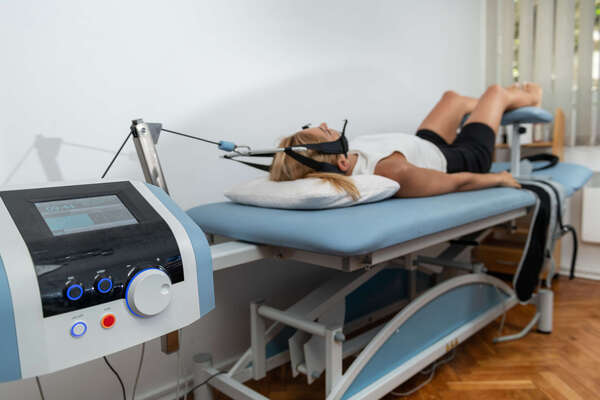
At the CCCV, we distinguish between treatments aimed specifically at restoring or improving joint mobility and the CBP® postural correction protocols, when indicated.
Postural correction is generally a more gradual process, since the goal is not simply to achieve immediate relief from symptoms but to modify certain measurable parameters.
Why worry about it before you feel any pain?
It is not a matter of systematically treating someone who has no symptoms.
Nor is it a matter of claiming that a particular posture will necessarily lead to pain or a medical condition.
The goal is different: to identify significant changes in posture, mobility, or function early enough.
As we get older, one question becomes particularly important:
What capabilities do we want to maintain in 10, 20, or 30 years?
Keep walking at a comfortable pace.
Exercise.
Travel.
Carry.
Get up from the floor.
Turn your head properly.
Maintain your balance.
And above all, remain independent.
Musculoskeletal prevention, therefore, is not just about ensuring the absence of pain today. It is also about preserving, as much as possible, the physical abilities needed to remain active in the future.
When should you have your spine and posture evaluated?
An assessment may be particularly relevant when the following are observed:
-
a gradual change in posture;
-
a head that seems to be leaning forward more and more;
-
a back that gradually rounds;
-
a significant decrease in mobility;
-
recurrent neck or lower back pain;
-
known scoliosis;
-
a decline in certain physical abilities;
-
or simply when you want to check how your spine is functioning.
The purpose of an evaluation is not necessarily to lead to treatment.
The primary purpose of a review is to understand and measure.
Our Approach at the CCCV: Measure to Decide
At the Spine Chiropractic Center, our approach is based on a simple principle:
We cannot seriously discuss correction without first measuring what we are trying to correct.
We combine clinical examination, postural analysis, objective measurements, and, when indicated, imaging to develop a treatment plan tailored to each patient.
Our goal is not to seek perfect posture or to promise that correcting posture will prevent the effects of aging.
It's much more concrete:
to preserve mobility, function, and independence as much as possible over time.
And when we seek to change a postural parameter, we want to be able to measure it beforehand and reassess it afterward.