

Cervical Disc Protrusion and Herniation: What Does Your Report Mean?
Does your cervical MRI report mention a “disc protrusion, ” a “cervical disc herniation, ” a “disc extrusion,” or a “disc-root impingement”?
These terms describe the shape and position of an intervertebral disc on imaging. However, they alone are not enough to determine whether the disc shown is the cause of your pain.
A protrusion or herniation must always be evaluated based on its location, its relationship to the nerve roots or spinal cord, the patient’s symptoms, and the neurological examination.
What is a cervical disc protrusion?
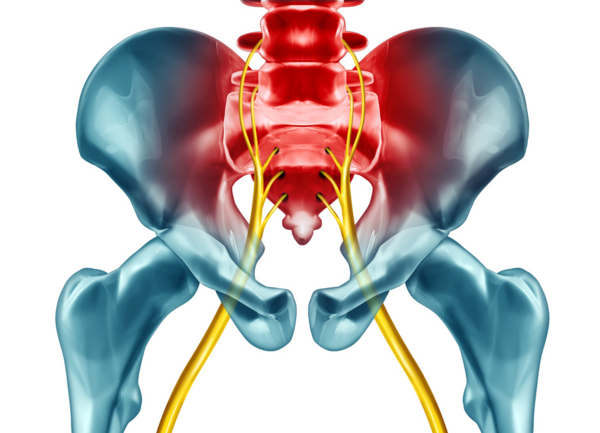
Intervertebral discs are located between the vertebrae and play a role in mobility and the transmission of stress in the cervical spine.
A disc protrusion refers to a localized displacement of the disc's outline beyond its normal boundaries.
The disc remains continuous with its original base, and the term essentially describes a morphological feature observed in the imaging.
A protrusion can be central, posterolateral, or foraminous, depending on its direction.
Its presence does not automatically mean that it is compressing a nerve structure or causing symptoms.
What is the difference between a disc protrusion and a herniated disc?
Radiology terminology may vary slightly from one report to another, but it is helpful to distinguish between several different situations.
A bulging disc generally refers to a relatively large protrusion of the disc's outline.
A protrusion refers to a more localized displacement of disc material.
A disc extrusion is a herniation in which the displaced material extends further beyond its original base.
Sequestration refers to the presence of a disc fragment that has lost its connection to the original disc.
These terms primarily describe the anatomical aspect of the lesion. They do not, on their own, serve as a measure of clinical severity.
Does a cervical protrusion or herniation always cause pain?
Cervical disc abnormalities may be observed in people who do not experience any pain.
Studies conducted on asymptomatic volunteers have shown that disc protrusions and other disc changes become more common with age.
This means that a protrusion detected on an MRI may be clinically significant in one patient and an incidental finding in another.
Therefore, we must avoid the following line of reasoning:
"The MRI shows I have a hernia, so my pain must be coming from that hernia."
The relevant question is rather:
"Does this herniation correspond exactly to my symptoms and my neurological examination?"
When can a cervical disc herniation become symptomatic?
A hernia can become clinically significant when it irritates or compresses a nerve structure.
When it affects a cervical nerve root, it can cause pain that radiates to the shoulder, arm, forearm, or hand.
This pain may be accompanied by:
tingling;
numbness;
change in sensitivity;
a decrease in certain reflexes;
or, in some cases, loss of muscle strength.
When these symptoms are caused by functional impairment of a nerve root, the condition is referred to as cervical radiculopathy.
What is a disco-radicular conflict?
A report may mention a:
“disco-radicular conflict,”
“contact with the root,”
“radicular compression”
or “foraminal conflict.”
These terms indicate that the disc is located near a nerve root or is putting pressure on it.
But even here, the image alone isn't enough.
For a conflict to be considered clinically relevant, there must be agreement between:
the affected cervical level;
the right or left side;
the location of the pain;
any sensory disturbances;
muscle strength;
and neurological reflexes.
For example, a protrusion on the right side does not automatically explain symptoms that are limited to the left arm.
Herniated Disc and Foraminal Stenosis: What's the Difference?
A herniated disc can itself reduce the available space around a nerve root.
However, foraminal stenosis may also be associated with other conditions, including disc height loss, uncarthrosis, or osteophytes.
Several mechanisms can therefore coexist in the same patient.
Understanding Cervical Foraminal Stenosis
https://www.chiropractic.fr/articles/articles/stenose-foraminale-cervicale-que-signifie-votre-compte-rendu
Can a cervical herniated disc compress the spinal cord?
Yes, in certain situations.
A herniated disc near the spinal canal can reduce the space available around the spinal cord.
However, the mere presence of a lesion on an MRI scan does not automatically mean that there is neurological damage.
When spinal cord compression causes neurological symptoms and signs, it may indicate cervical myelopathy.
Symptoms such as:
problems with walking or balance;
unusual clumsiness of the hands;
difficulty with fine motor skills;
progressive weakness;
or other widespread neurological symptoms should prompt a prompt specialized medical evaluation.
Can a cervical herniated disc heal on its own?
Yes, that has been documented.
Some cervical herniations may shrink over time without surgery.
A literature review that analyzed 75 published cases of spontaneous regression—to which the authors added a new case—found an average time span of approximately 9 months between the initial imaging and the documented regression.
Extruded or sequestrated hernias appeared to be more likely to resolve than simple protrusions.
However, these data should be interpreted with caution: they consist primarily of published cases rather than studies that would allow for a precise determination of the probability of remission in each patient.
Furthermore, radiographic regression is not necessary to achieve clinical improvement.
Protrusion and extrusion: Is the largest hernia necessarily the most painful?
The severity of symptoms does not depend solely on the apparent size of the hernia.
Its location, the amount of space available around the nerve structures, local inflammation, and, above all, consistency with the neurological examination are also important.
A small herniation located precisely where it contacts a nerve root may cause symptoms, whereas a larger protrusion may sometimes be found in a person with few or no symptoms.
How is a cervical disc herniation treated?
In the absence of significant or progressive neurological deficits and other signs requiring specialized intervention, conservative management can generally be considered as a first-line treatment.
Depending on the situation, it may include, among other things:
maintaining or gradually resuming operations;
appropriate therapeutic exercises;
mobility and strengthening exercises;
pain management;
and certain manual approaches tailored to the clinical situation.
The progression of symptoms and, above all, neurological function must be monitored.
What role does chiropractic play?
For some patients with neck pain or radicular symptoms associated with a disc protrusion or herniation, chiropractic care may be considered following a thorough clinical and neurological examination.
The techniques must be tailored to clinical findings and imaging results, when available.
The goal is not to claim to “put the disc back in place,” but to address the symptoms, mobility, and function when conservative management is appropriate.
When a measurable postural change is also present, it can be assessed separately.
Learn about our CBP® approach to postural correction
https://www.chiropractic.fr/la-technique
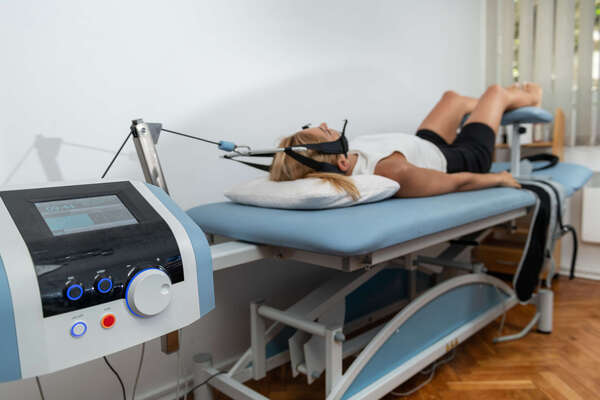
Can cervical traction push a herniated disc back into place?
It is best to avoid this phrasing.
Traction or any other conservative treatment should not be presented as a method that mechanically “pushes back” or “repositions” a herniated disc.
Symptoms may improve for various reasons without the disc’s structure immediately returning to normal on an MRI.
Any reduction in the herniated material over time is the result of complex biological mechanisms and cannot be attributed simply to manipulation or traction.
When might an infiltration procedure be considered?
When radicular pain remains severe despite appropriate conservative treatment, certain nerve blocks may be considered in selected patients in consultation with a specialist.
The choice depends, in particular, on the cause of the symptoms, their severity, their duration, and the neurological and radiological findings.
Therefore, an injection is not indicated based solely on the presence of a protrusion on the MRI.
When should you seek a surgical consultation?
The presence of a cervical hernia does not automatically mean that surgery will be necessary.
A surgical consultation becomes particularly important when:
a significant or progressive motor deficit;
signs of spinal cord compression;
severe or persistent radiculopathy despite appropriate conservative treatment;
or a clear correlation between significant neurological compression, symptoms, and the clinical examination.
The goal of any potential procedure is therefore primarily to relieve pressure on the affected nerve structures, rather than simply to eliminate an abnormality visible on an MRI.
What your report says — and what it doesn't say
"C5-C6 disc protrusion" describes the morphology of a disc.
That doesn't automatically mean:
that this protrusion is causing your pain;
that a nerve is compressed;
that it will inevitably get worse;
or that surgery will be necessary.
Its true significance depends on the consistency between imaging findings, symptoms, and the neurological examination.
Key takeaways
A herniated disc does not necessarily cause pain.
A herniated disc does not necessarily mean radiculopathy.
Contact with a nerve root ≠ necessarily a neurological deficit.
A herniated disc does not necessarily require surgery.
Some cervical herniations may even resolve on their own over time.
Treatment decisions must therefore be based on the patient as a whole, rather than on the MRI results alone.
Does your MRI show a cervical disc protrusion or herniation?
If your report mentions a protrusion, herniation, extrusion, or disc-root impingement, and you want to understand how this relates to your symptoms, a clinical and neurological evaluation can help determine the appropriate course of action.
Learn more about the assessment of neck pain at the CCCV
https://www.chiropractic.fr/cervicalgie-paris
Understanding Cervical Disc Disease
https://www.chiropractic.fr/articles/articles/discopathie-cervicale-que-signifie-ce-terme-sur-votre-compte-rendu