

Understanding scoliosis surgery
The diagnosis of scoliosis often raises a host of questions and concerns about the future.
How did this happen?
What are the treatment options for scoliosis?
Is scoliosis surgery necessary?
Managing these uncertainties is essential to making informed decisions.
Overview of scoliosis surgery
This article provides an overview of scoliosis surgery, including when it may be considered, what the procedure entails and what to expect during recovery. Our goal is to provide you with the knowledge you need to understand scoliosis surgery and make informed, confident choices for your health or that of a loved one.
When should surgery be considered?
Surgery may be considered in certain cases of severe or progressive scoliosis, when the deformity causes significant impairment or when the balance between the expected benefits and the risks of the procedure is deemed favorable.
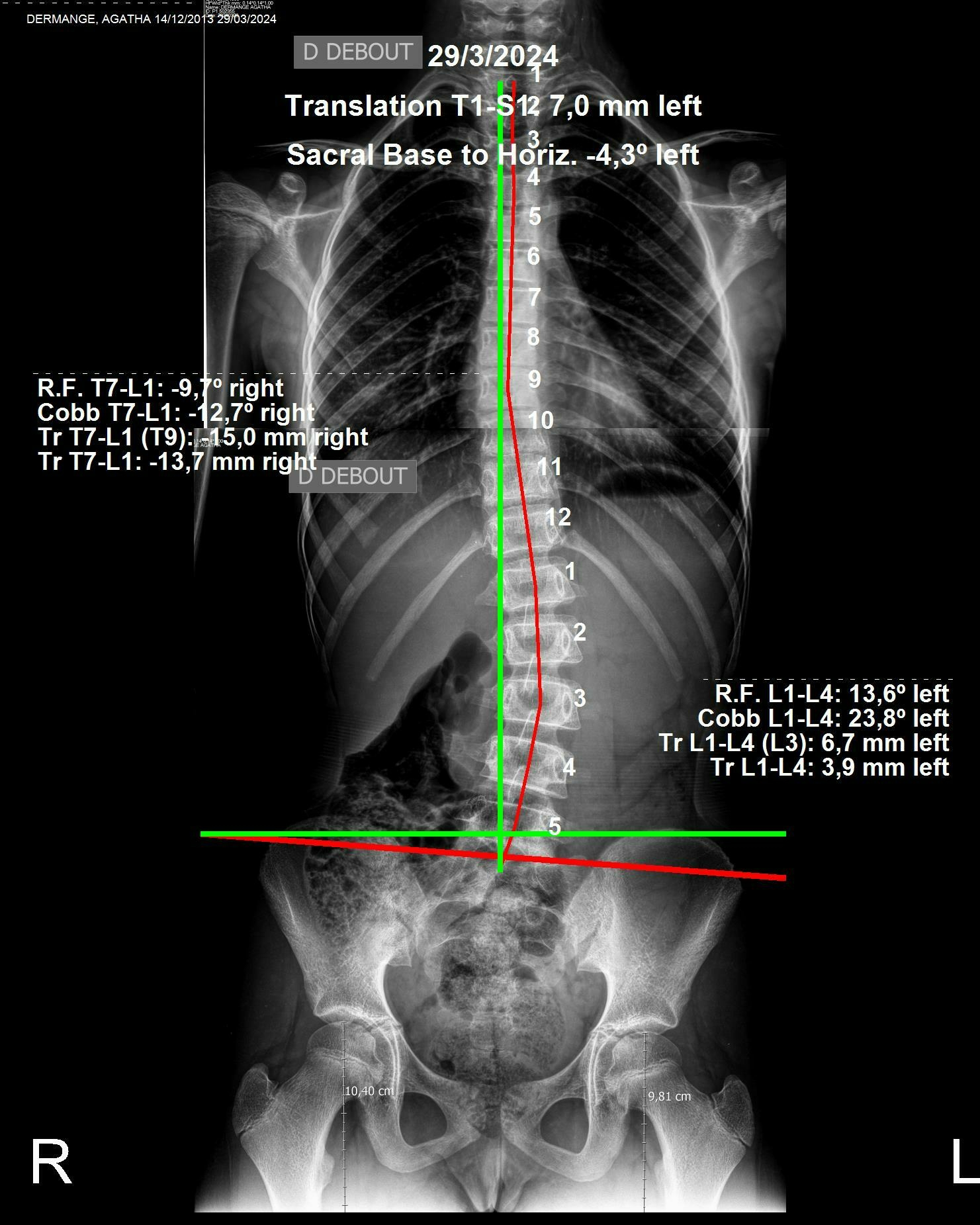
The decision depends on many factors: the severity and progression of the curvature, the overall alignment of the spine, age, skeletal maturity, pain and functional limitations, as well as—in certain very severe deformities—the impact on breathing.
In adolescents, surgery may be considered, particularly for certain severe curvatures that carry a high risk of progression. In adults, the Cobb angle alone is not sufficient: pain, function, sagittal and coronal balance, any neurological symptoms, and the impact on quality of life are all factors in the decision.
Conservative treatments—monitoring, specific exercises, and, when indicated, a brace—may be recommended depending on the situation. The decision to proceed with surgery is based on a specialized, individualized evaluation.
What is scoliosis surgery?
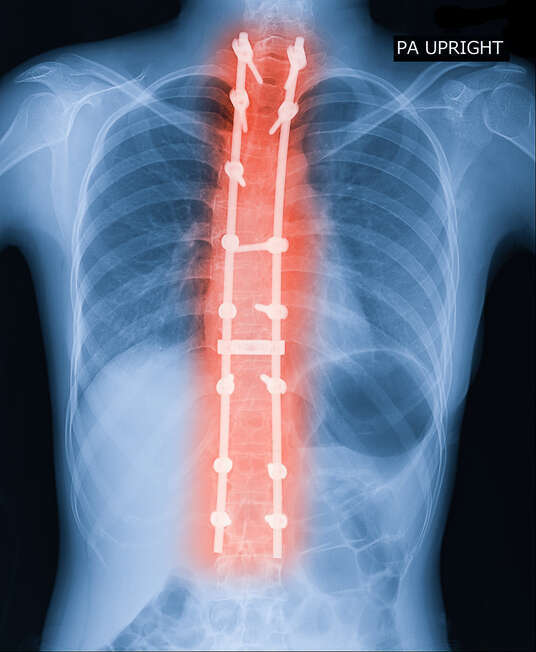
Scoliosis surgery most often involves instrumented correction combined with spinal fusion. Its goal is to partially correct the deformity, restore the spine’s balance as much as possible, and provide long-term stabilization of the affected segments.
During the procedure, the surgeon typically uses implants—such as screws and rods—in combination with a bone graft to gradually achieve fusion of the selected vertebrae. The goal is not necessarily to achieve a perfectly straight spine, but rather a balanced correction tailored to each patient.
The extent of the fusion and the technique used depend, in particular, on the type of scoliosis, its location, its stiffness, and the overall balance of the spine.
After surgery, a period of hospitalization followed by a gradual recovery is necessary. The duration and specifics of resuming normal activities vary depending on the procedure and the patient and are determined by the surgical team.
Risks of scoliosis surgery
Like any major surgical procedure, scoliosis surgery carries risks. The frequency of these risks varies depending on the patient’s age, overall health, the type of deformity, and the extent of the procedure.
Possible complications include infection, bleeding, anesthesia-related complications, healing problems, failure of bone union, or complications related to the implanted material.
Neurological complications may also occur, but serious neurological complications remain rare. Spinal fusion also results in reduced mobility of the fused segments; the consequences of this depend, in particular, on the extent and location of the fusion.
The expected benefits and risks specific to each situation should be discussed with the specialist surgeon before any decision to proceed with surgery is made.
Conservative Treatments for Scoliosis
Not all cases of scoliosis require surgery. Depending on the patient’s age, growth potential, the severity and progression of the curvature, and the symptoms, various conservative treatment strategies may be considered.
In children and adolescents, the goal may be, in particular, to limit the risk of progression during growth. In adults, the goals focus more on function, symptoms, and, in certain situations, the progression of the deformity.
1. Custom-made brace: For some growing children and adolescents at risk of progression, a brace may be recommended to reduce the risk of the curvature worsening. Its design and wearing instructions are tailored to the patient and the characteristics of their scoliosis. In adults, the indications and goals for brace use are different and must be individualized.
2. Scoliosis-specific exercises: Scoliosis-specific exercises (PSSE) are based, in particular, on the principles of three-dimensional self-correction, postural control, and the integration of corrected posture into activities of daily living. They can also improve mobility, function, strength, and muscular endurance.
In the clinic, this approach may include ScoliBalance®, with a personalized program tailored to the patient’s type of scoliosis, age, symptoms, and goals.
Depending on the clinical situation, specific exercises may be recommended on their own or as a supplement to brace treatment. For growing children and adolescents, their role in treatment depends primarily on the severity of the curvature and the risk of progression.
Treatment must be tailored to the individual. Monitoring, specific exercises, a brace, and, in certain situations, a surgical evaluation may be indicated for different reasons depending on the patient’s age, remaining growth potential, the severity and progression of the scoliosis, the symptoms, and the patient’s goals.
Our approach at Centre Chiropractic de la Colonne vertébrale
At the Spine Chiropractic Center, we prioritize conservative, individualized treatment for scoliosis when indicated. We also recognize that, in certain situations, a surgical evaluation may be necessary and may represent the most appropriate treatment option.
Our goal is to carefully assess each situation in order to guide the patient toward a treatment strategy tailored to their age, the progression of their scoliosis, their symptoms, and their goals.
Scoliosis surgery is an important decision that requires a thorough understanding of the expected benefits, risks, alternatives, and recovery process. When surgery is being considered, it should be discussed with a surgeon who specializes in spinal deformities.
When conservative management is indicated, various strategies may be considered depending on the patient, including monitoring, specific exercises, and a brace when indicated, with regular reassessment of progress.
Our goal is to help each patient understand their scoliosis and the various treatment options available so that they can make an informed decision about their care.
You can also send me an e-mail with your questions to
SCIENTIFIC REFERENCES
1. Negrini S, Donzelli S, Aulisa AG, et al.
2016 SOSORT guidelines: orthopedic and rehabilitation treatment of idiopathic scoliosis during growth.
Scoliosis and Spinal Disorders. 2018;13:3.
DOI: 10.1186/s13013-017-0145-8.
2. Bartley CE, Yaszay B, Bastrom TP, et al.
Perioperative and Delayed Major Complications Following Surgical Treatment of Adolescent Idiopathic Scoliosis.
Journal of Bone and Joint Surgery. 2017;99(14):1206–1212.
DOI: 10.2106/JBJS.16.01331.
3. Carreon LY, et al.
Complications following surgery for adolescent idiopathic scoliosis over a 13-year period.
Bone & Joint Journal. 2020.
Spine Chiropractic Center
119 University Street
75007
Paris
France
